In a changing climate, we get more weather whiplash: sudden downpours, long dry spells, unexpected heat. One of the simplest, most powerful ways to build a resilient garden biosphere is to work with rain itself — to catch it, slow it, and let it soak in where your plants and soil life can use it.
You do not need a large plot, fancy equipment, or engineering skills. With a few small shifts in how you shape your beds and choose materials, you can turn your garden into a sponge that stores water, protects soil life and supports biodiversity all year round.
Think Like Water: Capture, Slow, Sink
Before we get practical, it helps to see your garden the way water does. When it rains, water follows three main paths:
- Runoff – water that rushes across hard surfaces, eroding soil and carrying nutrients away.
- Evaporation – water that sits exposed and simply disappears into the air.
- Infiltration – water that sinks into the soil, feeding plants and soil organisms, and slowly topping up groundwater.
In a biosphere garden, we are always trying to shift water away from runoff and evaporation, and towards infiltration. A useful pattern to remember is:
Capture water where it falls, slow it as it moves, and sink it into living soil.
This means we want to:
- Offer water places to pause – in soil, mulch, or small depressions.
- Guide it gently across the garden instead of letting it race off paths and patios.
- Build soil structure so it can actually absorb and hold that water.
Small-Scale Rain Harvesting for Home Gardens
Many gardeners think of rainwater harvesting as big tanks and complex gutter systems. Those can be helpful, but there are also very simple ways to make the most of every shower, even in a small space.
1. Start With the Roof You Already Have
If you have a roof – a house, shed, or even a balcony overhang – you have a rain collector. The question is: where does that water go now, and could it do more for your garden on the way?
- Check downpipes: Does water go straight into a drain? If so, could you redirect part of that flow into a planted bed or a small rain garden area where soil and roots can absorb it?
- Use diverters and flexible hoses: Simple hardware-store diverters can split water so some continues to the drain while some flows into a water butt or planting area. Keep any changes safe and stable, especially in shared or paved spaces.
- Think overflow: Whenever you collect water (in a butt, barrel, or tray), ask where the overflow will go during heavy rain. Guide that overflow into soil rather than onto paths or neighbouring properties.
2. Make the Ground Softer, Not Harder
Many urban and suburban gardens lose most of their rainwater because so much surface is sealed: paving, decking, compacted paths. One of the most climate-smart, biosphere-friendly steps you can take is to quietly reverse this trend.
- Swap impermeable for permeable: Where safe and practical, replace solid paving stones with permeable versions, spaced slightly apart, or with gravel or woodchip paths. Water can move through these materials rather than bouncing off.
- Break up compaction: In heavy-use paths, lawns, or old beds, gently loosen the soil with a garden fork rather than turning it. Wiggle the fork back and forth to create vertical channels so water can reach deeper layers.
- Plant the gaps: Between slabs or along path edges, encourage low-growing plants and mosses. Their roots create micro-channels, and their leaves slow surface water so it has time to soak in.
3. Use Containers as Mini Reservoirs
In small courtyards or balconies, almost every drop is precious. Pots and planters can become part of your rain-storage system.
- Cluster containers: Group pots so that overflow from one drips into another, creating a cascade. Place thirstier plants lower down, where they catch more of this free irrigation.
- Widen the catchment: A narrow planter beneath a dripping edge or balcony rail can catch surprising amounts of water during a shower. Later, the moist soil acts like a small battery, slowly releasing water back to the plants.
- Mulch all pots: A simple layer of organic mulch (such as small bark, leaf mould, or partially composted material) on top of container soil reduces evaporation and keeps more of that captured rain available for roots and soil life.
Shape the Land: Swales, Basins and Rain Gardens
Even in very small gardens, subtle changes in shape can have a big impact on how water moves. The goal is not to create big ponds, but gentle dips and routes where water is invited to pause and soak in. Always keep safety and neighbouring properties in mind.
1. Simple On-Contour Swales
A swale is a shallow, level trench that runs roughly along the contour of a slope. Its job is to stop water rushing straight downhill and instead spread it gently along the line so it can sink into the soil.
To create a small garden swale:
- Notice the slope: After rain, where does water tend to run? That is where a swale can help.
- Mark a rough line: Use small flags, sticks, or a hose laid on the ground along the slope where you would like water to pause.
- Shallow dig: Dig a trench the depth of your spade blade or less, making it wide enough to be safe and easy to step across.
- Build a soft berm: Place the removed soil on the downhill side to form a low mound. Plant this berm with deep-rooted, water-tolerant species to stabilise it.
- Mulch the trench: Fill the base of the swale with organic matter such as woodchips or coarse compost. This acts like a sponge, holding water for longer.
On very small slopes, even a gentle, mulched groove between beds can function as a swale, feeding adjacent plants during and after rain.
2. Micro-Basins Around Plants
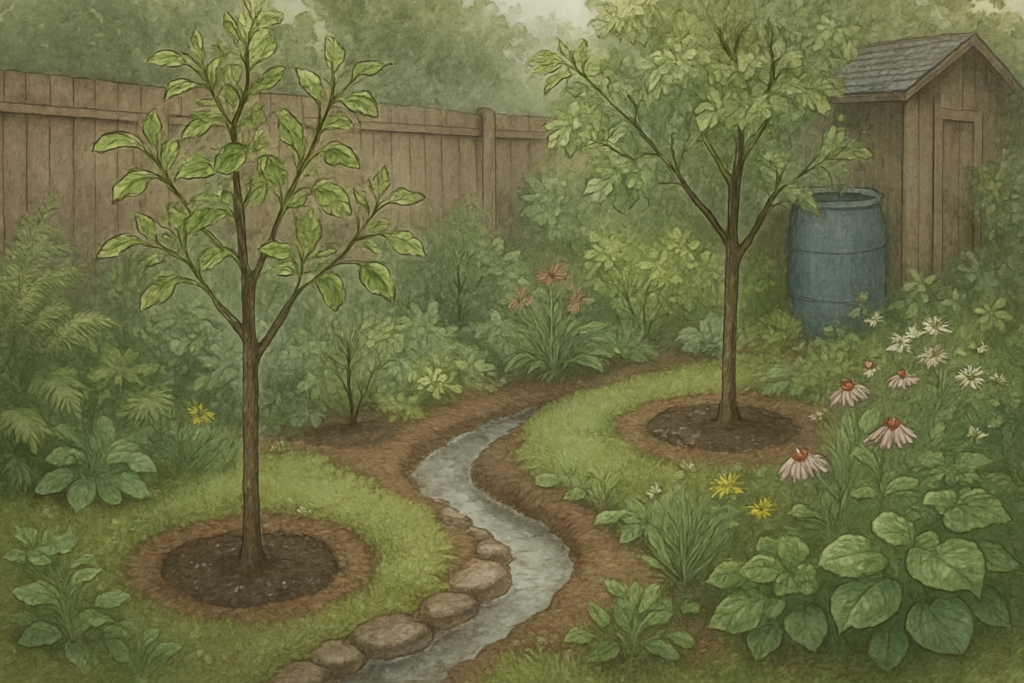
Micro-basins are small, bowl-shaped depressions around individual plants or small groups. They catch and concentrate water at the root zone, which is especially useful for new trees, shrubs, and perennials.
- Shape a ring: Form a circular lip of soil just beyond the drip line of the plant (where the outermost leaves reach). This lip holds rainfall like a saucer around a cup.
- Keep the base porous: Loosen the soil inside the ring and mulch it well. This ensures water can move down, not sideways and away.
- Adjust over time: As the plant establishes and roots deepen, you can gradually flatten the basin so water spreads a little further out.
3. Small Rain Gardens in Wet Spots
If there is a place in your garden that always seems to get soggy after rain, consider turning it into a small rain garden instead of fighting it. A rain garden is a planted depression designed to receive and filter runoff from surrounding areas.
Key principles for a healthy, biosphere-friendly rain garden:
- Choose the right depth: A shallow bowl that holds water briefly before it soaks in is usually safer and more useful than a deep pit. You are aiming for hours of moisture, not days of standing water.
- Layer the soil: If needed, improve the base with coarse organic matter so water can percolate through. Avoid creating a sealed container that simply fills and stagnates.
- Plant for diversity: Mix moisture-tolerant grasses, flowering perennials and small shrubs. Their different root systems knit the soil, offer nectar and shelter, and create a tiny wetland edge that many species can use.
Healthy Soil: Your Biggest Water Storage Tank
All the shaping and redirecting in the world will not help much if your soil cannot hold water. In a biosphere garden, healthy soil is the real reservoir.
Steps to increase your soil’s water-holding capacity:
- Add organic matter regularly: Well-rotted compost, leaf mould, and garden-made mulches feed soil organisms that create stable crumbs and pores. These tiny spaces store water like thousands of miniature cisterns.
- Protect the surface: Bare soil is vulnerable to crusting, which sheds water, and to rapid evaporation. A living plant cover or organic mulch layer turns the surface into a gentle sponge instead of a hard shell.
- Encourage roots at many depths: Mix shallow-rooted groundcovers, medium perennials, and deeper shrubs. Their roots create pathways for water to move down and later back up as plants lift moisture to the surface.
As your soil gains structure and organic content, you will notice that even after heavy rain it drains more gracefully, with fewer puddles and more consistent moisture days later.
Reading Your Garden After Rain
The most useful tool in building a rain-ready garden is simple observation. The next time it rains, put on waterproofs and go outside. Watch, listen, and make notes.
- Where does water race? That is a place to slow.
- Where does it pool unpleasantly? That is a place to shape or plant differently.
- Where does it quietly soak in? That is a pattern to copy elsewhere.
Over time, with a few small adjustments each season, your garden can move from shedding water to welcoming it – supporting richer soil life, deeper-rooted plants and a more resilient, climate-smart biosphere just outside your door.