Annuals give quick colour, but perennials quietly build the backbone of a resilient garden biosphere. Once they settle in, roots deepen, soil life flourishes, and each season asks less from you and offers more back to the wider web of life.
This post is about choosing and combining perennials so you get a garden that is beautiful, climate‑smart and genuinely low‑work. No plant encyclopaedia, no Latin lists to memorise – just clear patterns you can use with the plants you already love or can easily find.
Why Perennials Are Biosphere All‑Stars
Perennials are plants that live for several years or more. Instead of restarting from seed each spring, they wake up from roots, crowns or woody stems that stay in place. That simple habit changes everything for your garden biosphere.
- Deeper, steadier roots: As perennials mature, their roots reach deeper and spread wider. That helps them find water during dry spells and hold soil during heavy rain.
- More carbon in the ground: Long‑lived roots feed soil organisms year after year. As roots grow and die, carbon is stored in soil rather than released quickly to the air.
- Stable habitat for wildlife: Many insects, spiders and soil creatures depend on long‑lived plants for shelter, nectar, pollen and overwintering spots.
- Less digging, less disturbance: Fewer bare patches and less turning of soil keeps fungal networks and soil structure intact.
- Less work for you: Once established, many perennials need only light pruning, an annual mulch and the odd divide or replant.
Think of perennials as the permanent residents of your garden community. Get those right, and you can sprinkle annuals on top for extra colour or food without destabilising the system.
Start With Roles, Not Plant Names
Instead of starting with a list of “best perennials”, start with the roles you want plants to play in your biosphere. Then you can match those roles to the plants that thrive in your specific climate and soil.
Here are five key roles that make a perennial garden both beautiful and resilient:
- Ground‑tuckers (living mulch)
- Filler flowers (the main show)
- Architects (height and structure)
- Fixers and feeders (support plants)
- Edges and path‑keepers (where you actually walk)
You do not need dozens of varieties. Even one or two plants in each category, repeated through the garden, can create a strong, coherent biosphere.
1. Ground‑Tuckers: Living Mulch That Works All Year
Ground‑tuckers are low, spreading perennials that knit the soil surface together. They help you cover bare earth – which is vital for soil life and moisture – without relying only on bark or gravel.
Look for plants that are:
- Low and spreading rather than tall and clumping.
- Happy in your light conditions (sun, part shade, full shade).
- Polite spreaders, not thugs that swallow everything.
Useful types include:
- Herbaceous carpets: small, leafy mats that weave between stepping stones and under shrubs.
- Flowering drifts: low perennials that bloom but still hold soil most of the year.
- Evergreens: plants that keep some cover through winter, sheltering soil life and overwintering insects.
Place ground‑tuckers anywhere you can see bare earth: at the feet of taller perennials, around shrubs, under young trees, or along path edges.
2. Filler Flowers: Colour, Nectar and Seasonal Rhythm
Filler flowers are the heart of your planting – the perennials that give you colour, scent and movement through the growing season. They also provide much of the nectar and pollen that pollinators rely on.
When choosing filler flowers, aim for:
- A long season: choose a mix that flowers in early, mid and late season so there is always something for insects.
- Open, accessible blooms: simple flower shapes are easier for a wide range of pollinators than heavily doubled forms.
- Sturdy stems: plants that stand without staking in your conditions (exposed, sheltered, windy, dry).
A simple pattern is:
- Early season: low clumps that wake up quickly and feed emerging insects.
- Mid season: your main show – the plants people notice from the path or window.
- Late season: perennials that keep going into autumn, bridging the gap to seed heads and winter structure.
Repeat your chosen fillers in small drifts through the garden rather than dotting one of everything. This makes it easier for insects to find what they need and easier for your eye to rest on coherent blocks of colour.
3. Architects: Plants That Hold the Space Together
Architect plants give height and backbone. They stop a border feeling flat or fussy and offer perches, stems and seed heads for wildlife.
Architects can be:
- Tall, upright perennials that sway in the wind and catch light.
- Clump‑forming grasses that add movement and winter silhouettes.
- Small shrubs or sub‑shrubs that stay leafy through more of the year.
Use them to:
- Mark corners and transitions in beds.
- Create backdrops for lower flowers.
- Guide sight‑lines from windows, doors or garden seats.
In a small garden, even one or two well‑placed architectural perennials can be enough. The key is to repeat them to create rhythm and to leave plenty of room around them for lower companions.
4. Fixers and Feeders: Quiet Support for Soil and Neighbours
Fixers and feeders are the plants that quietly support the rest of your biosphere. Some are known for working with microbes to bring extra nutrients into the soil; others exude root sugars that feed fungal networks or mine minerals from deeper layers.
Look for perennials that are:
- Well‑adapted to your local climate and soil, so they thrive without extra feeding.
- Happy to be cut back and used as a light mulch in place, returning nutrients to the topsoil.
- Attractive to beneficial insects, providing nectar, pollen or shelter.
You do not need to understand every chemical pathway to benefit from these plants. Simply including some deep‑rooted, tough perennials and a few nectar‑rich supporters near your main crops or more delicate ornamentals can lift the whole system.
5. Edges and Path‑Keepers: Where People and Plants Meet
Edges are where garden life and human movement constantly rub up against each other. Getting your edge plants right means fewer broken stems, less trampling and a softer feel underfoot.
Good edge perennials are:
- Low and forgiving: they can cope with the odd foot or tool brushing past.
- Clearly different from lawn grass, so it is obvious where to step and where not to.
- Long‑season: they either keep foliage for much of the year or leave attractive stubble when cut back.
Use them to gently line paths, steps and bed edges. They create clear, living boundaries that guide you through the garden and protect more delicate plants behind.
A Simple Layering Recipe for Any Bed
You can use the roles above to sketch out almost any perennial area – from a tiny front strip to a large border. Here is a simple pattern you can adapt.
- Mark your edges. Decide exactly where you walk or mow. Add a single line of edge perennials along paths and lawn boundaries.
- Place your architects. Choose 3–5 points where you want height and structure (corners, behind seats, in front of a fence). Plant one architectural perennial in each, and repeat the same few species through the bed.
- Add filler flowers around them. In the spaces between and in front of architects, plant clumps of your chosen early, mid and late‑season fillers. Think in groups of 3, 5 or 7 plants of the same kind rather than singletons.
- Weave ground‑tuckers through bare soil. Wherever you can still see patches of earth, tuck in low spreaders. They will slowly knit the bed together.
- Slip fixers and feeders in close to hungry areas. Around fruit bushes, veg beds or thirsty ornamentals, add a few deep‑rooted or nutrient‑supporting perennials. Cut them lightly once or twice a year and let the cuttings fall as mulch.
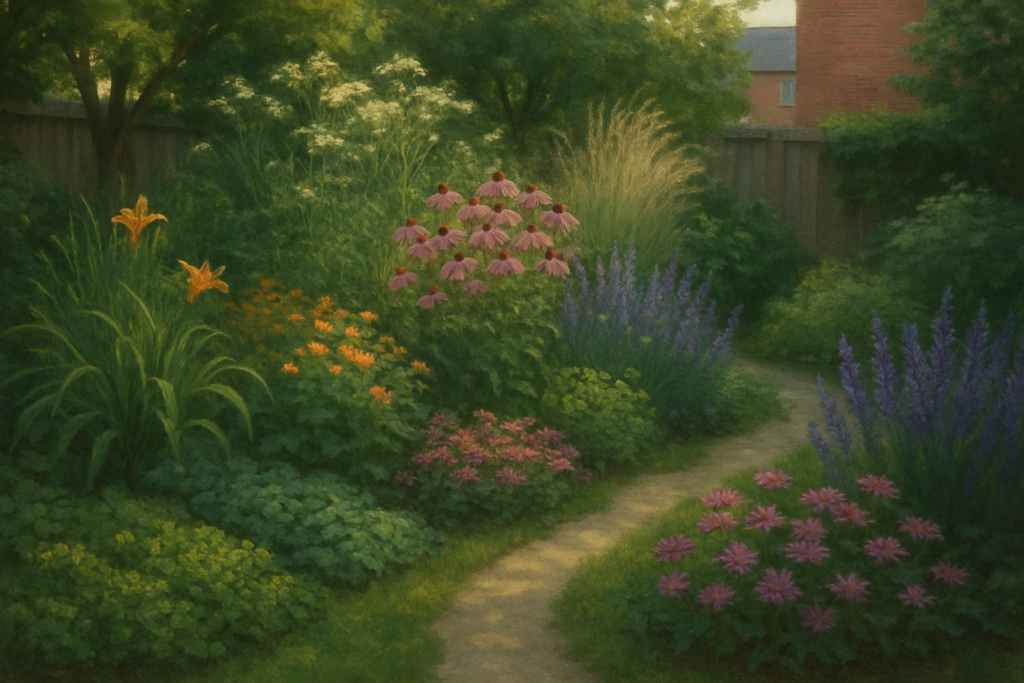
Stand back, and you will see a structure emerge: tall and airy at the back or centre, stepped down through fillers to low edges and ground‑tuckers. Over time, roots will interlace and soil cover will increase, making the whole bed more drought‑tolerant and self‑maintaining.
Keeping Perennials Healthy With Minimal Effort
Once your perennial biosphere is planted, the goal is to disturb the soil as little as possible while still keeping paths clear and plants vigorous.
A simple annual rhythm could look like this:
- Late winter / very early spring: Cut back last year’s stems, leaving any still full of seed or insect life until the first warm days. Chop soft material roughly and leave it on the surface as mulch where it falls, unless it is diseased.
- Spring: Top up mulch around newer plants and any areas that still show bare soil. Mulch can be homemade compost, well‑rotted plant matter, leaf mould or a light layer of chipped prunings.
- Summer: Focus on observation. Note which perennials are thriving or struggling. Water deeply but less often so roots go down, not sideways.
- Late summer / autumn: Divide overcrowded clumps, replanting pieces where you want more of that plant and sharing the rest. Leave seed heads standing on at least some plants for winter food and shelter.
Over time, your perennials will teach you what they need: some will self‑seed politely; others will ask for more space; a few will tell you clearly that your garden is not their place. That is part of building a biosphere – noticing who thrives and adjusting the community.
A perennial garden is not a finished picture; it is an evolving conversation between roots, soil, water, light and the beings who share the space.
If you focus on roles, layers and gentle care, you will find that the garden begins to get on with much of the work itself. Your task shifts from constant intervention to seasonal editing – and more time spent simply being in the living system you have helped create.